



How a decade of financial planning helped turn an unexpected career change into an opportunity to rethink life before retirement.
When David called me after being made redundant, we had plenty to talk about.
After spending much of his career with one organisation, he suddenly had an opportunity he hadn’t necessarily planned for: time to think about what he wanted the next stage of life to look like.
He and his wife, Sarah, were in their early 50s. We had worked together on their financial plan for around a decade, building and reviewing a strategy designed to support the things that mattered most to them. David decided to take several months away from work before making his next move.
And when he started considering what came next, the question wasn’t simply:
“Where can I earn the most money?”
It was something much more interesting.
“What kind of life do we wan t over the next ten years, and what role should work play in it?”
When the highest salary isn’t necessarily the best option
David had several possible paths. Returning to the private sector was one. Some opportunities had the potential to deliver higher short-term remuneration. Another was a permanent role in the Western Australian public sector.
On paper, the comparison might have looked straightforward: compare the salaries, consider the benefits and pick the better package.
But David and Sarah were thinking beyond the next pay cheque.
They wanted to consider the demands of work, job stability, the possibility of greater flexibility later in life and whether the next role would fit with their plans for retirement.
Financial independence changes the conversation.
When your financial position gives you room to choose, a career decision can become less about maximising earnings and more about finding the right balance between money, time and purpose.
For David and Sarah, that was the real opportunity.
The super account we’d kept in the background
There was another important piece of the puzzle.
David had retained a GESB West State Super account from his earlier employment in the WA public sector.
West State is a unique superannuation scheme, available primarily to existing members who worked in the WA public sector before April 2007. It is now closed to new members, and a member who closes their account generally cannot rejoin.
Throughout our ongoing advice relationship, we had considered whether keeping David’s account open remained appropriate.
For years, it wasn’t the centre of his financial strategy.
But when a return to the public sector became a real possibility, that decision to preserve flexibility took on new significance.
Sometimes the value of financial planning is in the options you don’t give up.
If you’d like a deeper explanation of the scheme, I’ve previously written about what makes GESB West State different from other super accounts.
A different way to think about salary, super and tax
After David secured the public-sector role, we considered how his employment income, West State account and existing investments could work together.
One recommendation involved directing a substantial proportion of his salary into West State through salary sacrifice.
The proposed amount was approximately $145,000 a year, assuming a full year of 26 fortnightly pay periods. Employer contributions would be additional and needed to be considered separately.
That’s a significant salary sacrifice strategy, and certainly not something that would suit everyone.
It also meant committing more money to super, where access is generally restricted until a condition of release is met. Keeping enough accessible money outside super was therefore an important part of the plan.
So why consider it?
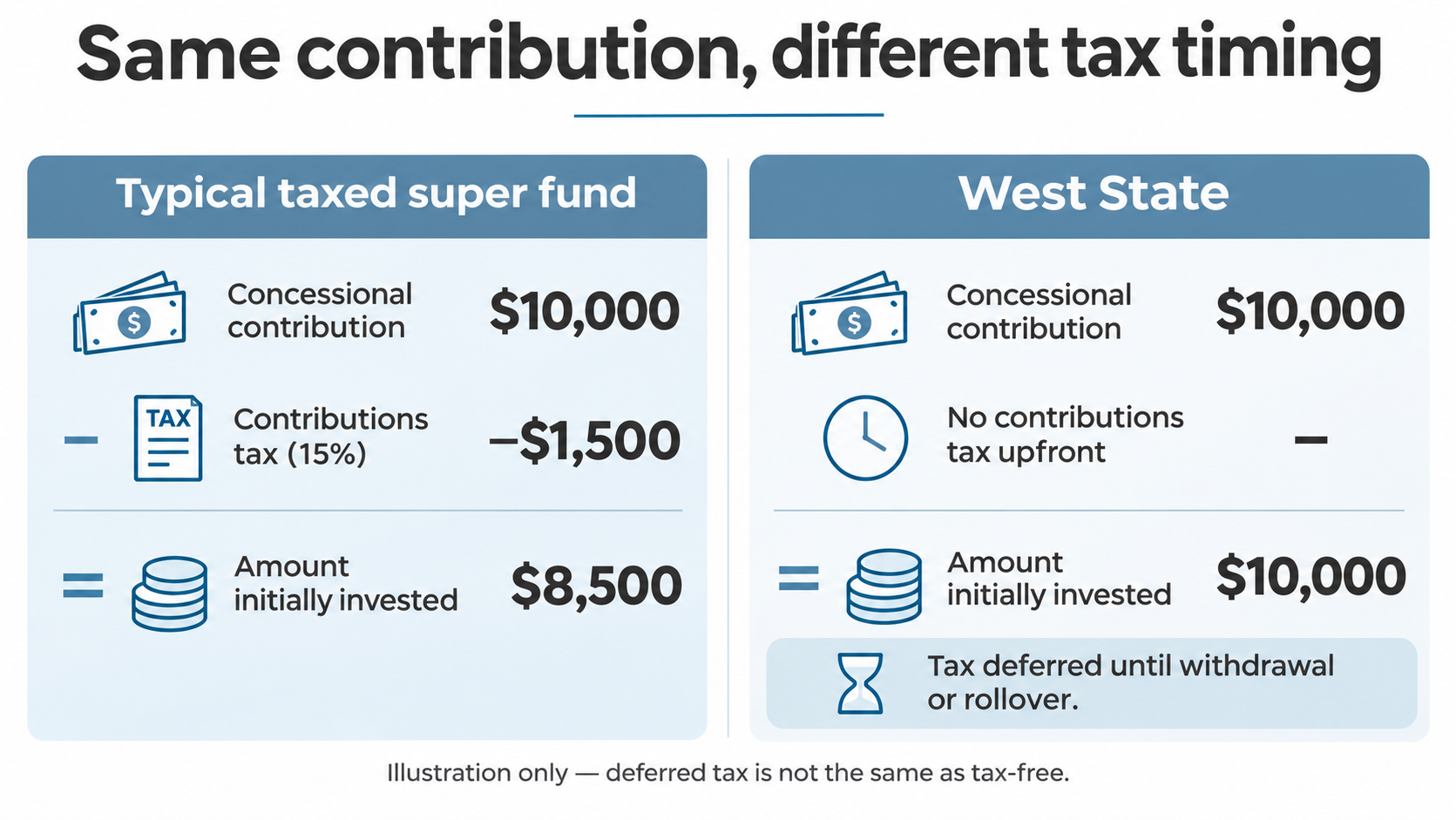
West State is an untaxed superannuation scheme. Unlike most conventional taxed super funds, tax generally isn’t deducted from concessional contributions when they enter West State. Tax is deferred until relevant benefits are accessed or transferred.
West State also has different contribution rules. Concessional contributions aren’t subject to the usual annual cap within West State, although an untaxed plan cap applies and those contributions can affect a person’s ability to make concessional contributions to other taxed super funds.
This can create opportunities, particularly for eligible members who have built up savings outside super and are approaching retirement.
But here’s the important distinction:
Deferring tax isn’t the same as avoiding tax.
The eventual result depends on the amount contributed, tax payable on accessing or transferring benefits, investment performance, contribution limits and the member’s overall circumstances.
That’s why we needed to analyse the strategy as part of David and Sarah’s wider financial position, not as a standalone tax-saving exercise.
The other half of the plan: living comfortably today
There was an obvious question.
If David was directing so much of his salary towards retirement savings, how would they continue paying for everyday life?
This is where the planning became particularly interesting.
David and Sarah had accumulated investments outside superannuation over many years. Their plan considered using approximately $10,000 per month from available family-trust cash to help fund their lifestyle, alongside maintaining a cash reserve equivalent to around 12 months of planned withdrawals.
In simple terms, the strategy looked at two sides of their finances working together:
- Employment income could be directed towards growing retirement savings through West State.
- Existing investments and cash could help meet current living expenses, supported by a planned liquidity buffer.
The cash reserve was intended to reduce the need to sell growth investments at an inconvenient time, although market risk, future returns, investment drawdowns and tax consequences still needed to be managed.
Importantly, we were also considering Sarah’s position, including opportunities to coordinate the couple’s superannuation contributions and retirement savings.
Rather than treating the family’s super accounts, investments, income and spending as separate issues, we brought them together into one financial plan.
The real value wasn’t just in the tax strategy
It’s tempting to judge financial advice purely by a number.
How much tax might be saved? How much more could super grow? Which investment produced the highest return?
Those are important questions, and sound financial modelling matters.
But in this situation, the bigger picture was just as important.
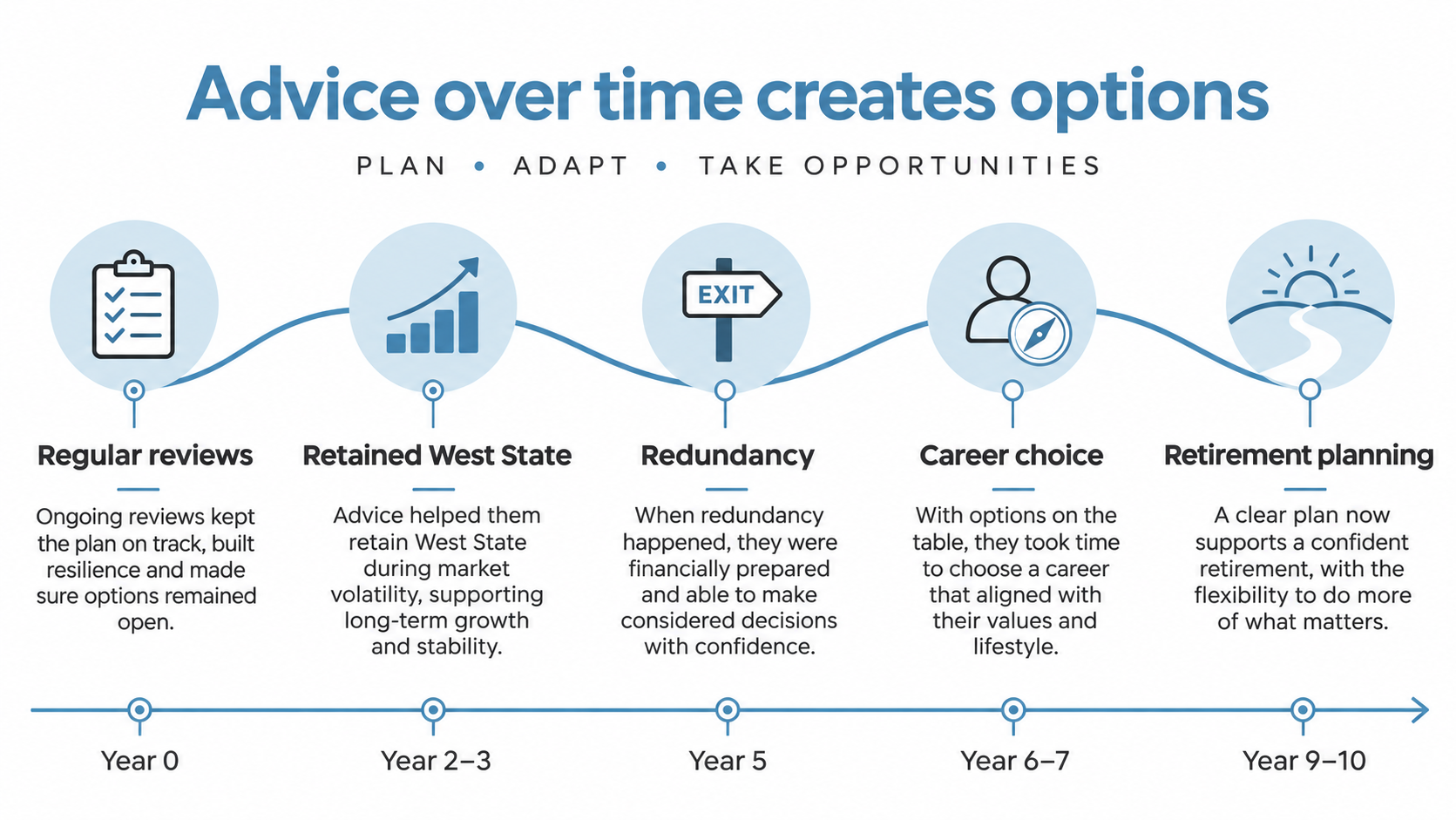
We had been working with David and Sarah for around ten years before redundancy brought their career choices into focus.
Those years of planning and regular reviews meant we weren’t starting from scratch when life changed.
We already understood their finances, their priorities and the broader direction they wanted their lives to take.
The aim was to help them make a decision from a position of preparation rather than pressure.
There was no need to assume that the highest-paying private-sector job must be the right one. Nor did we need to assume that public-sector employment or West State would automatically produce a better financial result.
Instead, we could weigh up the trade-offs and consider how the choices aligned with the couple’s long-term objectives.
That’s what financial advice for life means to me: not simply making better decisions about money, but helping people use their money to make better-informed decisions about life.
Three questions worth asking before your next career move
If you’re approaching retirement, facing redundancy or considering a return to government employment, David and Sarah’s situation highlights three useful questions.
- Am I comparing jobs or comparing lifestyles?
Salary matters. So do superannuation, employment conditions, leave, flexibility, career satisfaction and the impact of work on your life outside the office.
The best financial decision isn’t necessarily the option with the largest headline salary.
- Am I making the most of the opportunities I already have?
An existing West State account, investments outside super, accumulated savings or other financial arrangements may create planning opportunities.
Equally, those opportunities come with rules, costs, risks and tax consequences that should be properly understood.
- Does my financial plan give me choices?
A good plan should consider more than your intended retirement date.
It should help you understand what is possible if your circumstances change: whether that’s working less, changing careers, supporting your family or simply creating more room for the things that matter.
Your next chapter deserves a plan
Redundancy is rarely something people look forward to.
But sometimes an unexpected career change creates the space to ask questions we’ve been too busy to consider.
For David and Sarah, that meant looking beyond a salary comparison and connecting employment, superannuation, investments, tax, cash flow and retirement goals.
West State was an important part of the strategy. It wasn’t the whole story.
At HPH Solutions, we believe financial planning should help people live healthier, happier and more prosperous lives, with advice that evolves as their circumstances change.
If you’re approaching retirement, considering a career change or wondering how your GESB West State account fits into your bigger financial picture, get in touch with our team.
Let’s talk about what you want your next chapter to look like, and how your financial plan can help support it.
This case study uses pseudonyms and generalised details. The strategies described were recommendations for particular clients, not outcomes necessarily achieved. Figures are approximate and relate to the planning scenario described; they are not a representation of tax savings or investment results. This article contains general information only and does not consider your personal objectives, financial circumstances or needs. Superannuation rules, tax treatment and eligibility may change. Consider obtaining personal financial and tax advice appropriate to your circumstances before acting.