


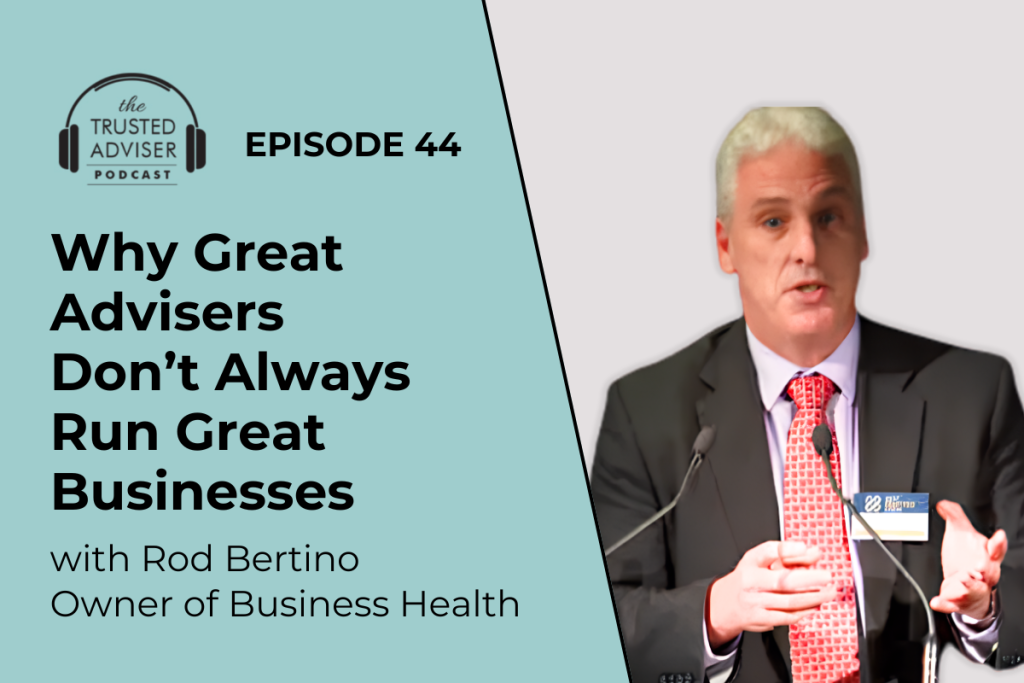
In this episode of the Trusted Adviser Podcast, Rob Pyne interviews Rod Bertino from Business Health, discussing the evolution of advisory practices and the importance of helping advisors transition into successful business owners. They explore the significance of data integrity in benchmarking, the current war for talent in the advisory sector, and the rising cybersecurity risks associated with hybrid work environments. Rod shares insights from a recent salary and remuneration report, emphasizing the need for firms to articulate their value to retain talent and build a strong company culture, especially when onboarding new staff in a hybrid setting.
In this conversation, Rob and Rod discuss the importance of understanding client value, team engagement, and the role of technology in financial advice. They emphasize the significance of independent business valuations and the implications of succession planning for financial advisory firms. The discussion highlights the need for firms to focus on their core values, the impact of technology on business processes, and the importance of preparing for the future to ensure the longevity and value of their businesses.
LISTEN
SHOW NOTES
Topics Discussed
- Business valuation and integrity of data
- Talent war and team retention strategies
- Hybrid work infrastructure and cybersecurity risks
- Impact of aging client base on business valuation
- Role of culture, career development, and compensation
- Why great financial advisors do not automatically become great business owners.
- The importance of high-integrity benchmarking and reliable business data.
- The growing “war for talent” in financial advice businesses.
- Why client support and back-office roles are becoming more valuable.
- Building culture and connection in hybrid work environments.
- Cybersecurity risks created by remote work arrangements.
- Why client feedback matters more than technical investment expertise.
- The “three C’s” of attracting and retaining great team members.
- Managing poor cultural fit and underperformance within teams.
- The reality of AI adoption inside advice practices.
- How technology can amplify broken processes if workflows are not fixed first.
- Independent practice valuations and the factors driving business value.
- The impact of aging client demographics on practice valuations.
- Why buyers value engaged teams, organic growth, and scalable systems.
- The hidden risk for self-licensed firms with a sole responsible manager.
- Business continuity and succession planning for advice firms.
Episode Highlights
(Timestamps are approximate)
- [00:00] – Introduction to Rod Bertino and Business Health
- [02:47] – Why advisory skill sets differ from business ownership skills
- [04:06] – The importance of benchmarking integrity and quality data
- [08:55] – Key findings from the salary and remuneration report
- [13:27] – Why demand for client support staff is rapidly increasing
- [16:32] – Cybersecurity risks in hybrid work environments
- [21:56] – Building culture and onboarding staff in remote teams
- [25:10] – Why talent has become the new battleground for advice firms
- [27:23] – Retaining staff through culture, career development, and leadership
- [30:13] – The power of client stories and feedback in building team purpose
- [35:52] – The “three C’s” framework for attracting and retaining talent
- [39:47] – Managing poor performers before culture deteriorates
- [41:46] – The reality of AI adoption inside advice businesses
- [46:20] – What most firms misunderstand about business valuations
- [52:53] – The biggest factors increasing or reducing practice value
- [58:12] – Why buyers prefer scalable technology and investment systems
- [01:00:00] – The hidden succession risk for self-licensed firms
- [01:01:19] – What happens when a sole responsible manager disappears
- [01:04:09] – Why business continuity planning is essential for families and clients
Quotes
- “Most owners are really talented advisors. Running a successful small business is a very different beast.” – Rod Bertino
- “The war for talent is the new advisory practice battleground.” – Rod Bertino
- “There is no remote work. There’s only work.” – Rod Bertino
- “If the process is broken, technology won’t fix it. It will just help you do more broken stuff faster.” – Rod Bertino
- “If they joined you for money, they will leave you for money.” – Rod Bertino
- “Culture, career development, and compensation. In that order.” – Rob Pyne
- “Clients rarely talk about asset allocation. They talk about trust, understanding, and confidence.” – Rod Bertino
- “The bad stuff happens to good people as well.” – Rod Bertino
- “If you go under that proverbial bus, potentially that capital value goes to zero.” – Rod Bertino
- “You have an obligation to your clients, your family, and your staff members to put a plan in place.” – Rod Bertino
Key Takeaways
- Business Health helps advisors become successful business owners.
- The skill set for advising differs from running a business.
- Data integrity in benchmarking is crucial for meaningful insights.
- The war for talent is the new battleground for advisory firms.
- Cybersecurity risks have increased with hybrid work environments.
- Onboarding new staff in a hybrid setting requires intentionality.
- Advisory firms need to articulate their value to retain talent.
- The demand for client support roles is rising in advisory practices.
- Building a strong company culture is essential in hybrid work.
- Feedback from clients is often overlooked by advisory firms. Understanding what clients truly value is crucial.
- Team engagement is enhanced by sharing client feedback.
- Compensation should not be the primary focus for candidates.
- The three C’s: culture, career development, and compensation matter.
- Hiring decisions should align with firm values and culture.
- Technology won’t fix broken processes; it can amplify them.
- Independent valuations provide objective insights into business worth.
- Aging client bases can significantly impact business valuations.
- Succession planning is essential for maintaining business value.
- Firms should prepare for unforeseen circumstances to protect their legacy.
Resources & Links
- The Trusted Adviser: https://thetrustedadviser.com.au/
- Business Health: http://www.businesshealth.com.au/
- Connect with Rob Pyne on LinkedIn
- Connect with Rod Bertino on LinkedIn
- Follow The Trusted Adviser Podcast
Show notes and transcript
For the full show notes and transcript from this episode, head to the episode page on The Trusted Adviser Website here.