


Important: These changes are not law.
Treasury released exposure draft legislation on 3 September 2026 for consultation. The proposal may change before legislation is introduced to and passed by Parliament.
Australia’s proposed changes to the taxation of discretionary trusts are significant. But the latest draft legislation is also a useful reminder of why major financial decisions should not be made on the strength of a headline.
When the Federal Government announced a proposed 30% minimum tax on discretionary trusts in the May 2026 Budget, many family trust owners understandably wondered whether they needed to act immediately.
- Should we restructure the trust?
- Should we stop using a bucket company?
- Should we change the way income is distributed?
- Could a structure that has worked for our family for years suddenly become unsuitable?
Those were reasonable questions.
One of the biggest concerns at the time related to bucket companies. Under the original announcement, corporate beneficiaries were not proposed to receive a credit for the minimum tax paid by the trust. That created the possibility that the same income could effectively be taxed once at the trust level and then again when distributed to the company.
For families using corporate beneficiaries as part of an established business or investment structure, that understandably raised alarm.
Our view at the time was to pay attention, understand the potential impact, but avoid making irreversible decisions before the rules became clearer.
The exposure draft released by Treasury on 3 September 2026 shows why.
Most notably, the draft appears to address one of the biggest concerns from the original announcement: bucket companies may no longer face the same potential double-tax outcome that was initially feared.
Under the proposed framework, an eligible existing discretionary trust may be able to elect into a fixed-distribution regime and nominate an eligible corporate beneficiary. Treasury’s own material indicates that, where the requirements are met, future income distributed to that company could be taxed only as income of the company rather than also being subject to the proposed 30% trust minimum tax.
That is a material shift from how the proposal was initially understood.
It does not mean bucket companies simply continue unchanged, nor does it mean every family trust will have an obvious solution. The proposed election comes with conditions and, importantly, potentially less flexibility over how trust income can be distributed in future.
But it does mean the conversation has changed.
What are the proposed family trust tax changes?
Under the Government’s proposal, from 1 July 2028 many discretionary trusts would become subject to a minimum tax rate of 30%.
Broadly, the trustee would pay the minimum tax.
Beneficiaries would continue to include their share of trust income in their tax returns and, under the proposed framework, non-corporate beneficiaries would generally receive a non-refundable credit for tax paid by the trustee.
The fact that the credit is proposed to be non-refundable is important.
If the beneficiary would otherwise pay more than 30% tax on that income, the credit may reduce the additional tax payable.
If the beneficiary would otherwise pay less than 30%, however, the difference would generally not simply be refunded.
That is central to the policy intent.
The Government has said the reform is designed to reduce the ability to use discretionary distributions to achieve tax outcomes that are not available to people earning comparable income through wages.
For families that have legitimately used trusts for business ownership, investment, asset protection, estate planning or intergenerational wealth management, however, the consequences extend well beyond a single tax rate.
Why were bucket companies such a concern after the May Budget?
A common feature of many private family groups is a corporate beneficiary, often referred to as a bucket company.
Instead of distributing all trust income to individuals who may be taxed at higher marginal rates, a trust may make an eligible company entitled to part of that income.
The company pays tax at the applicable corporate rate, with further personal tax consequences potentially arising later when profits are ultimately extracted from the company.
This is not a tax-free arrangement. Existing rules including Division 7A, section 100A and other integrity provisions already need to be considered carefully.
But corporate beneficiaries have long formed part of many legitimate family business and investment structures.
The original Budget announcement created concern because corporate beneficiaries were not proposed to receive a credit for the minimum tax paid by the trust.
That raised the possibility of trust income effectively being taxed at the trust level and then again in the company.
Understandably, this led to widespread commentary that bucket-company strategies could become significantly less attractive or, in some circumstances, unworkable.
The 3 September draft has changed that conversation.
What changed in the 3 September 2026 exposure draft?
Treasury has now proposed a new option for eligible discretionary trusts that already exist when the reforms are due to commence.
Under the draft framework, a trust may be able to elect to make fixed distributions to pre-nominated beneficiaries and, as a result, fall outside the proposed minimum-tax regime.
Importantly, Treasury says the nominated beneficiaries may include eligible companies and trusts.
Treasury’s own fact sheet gives an example of a trust nominating an eligible company and having future income distributed to that company, with that income taxed only as income of the company.
That is a substantial development.
However, that benefit comes with an important trade-off.
The trade-off: tax certainty versus flexibility
A discretionary trust is valuable partly because it is discretionary.
Subject to the trust deed and tax law, the trustee may be able to determine which eligible beneficiaries receive income and in what proportions.
That flexibility can be particularly useful as families change over time.
- Children grow up.
- People join or leave a family business.
- Relationships change.
- Income levels change.
- Succession plans evolve.
- New investment or asset-protection needs emerge.
The proposed fixed-distribution election would require nominated beneficiaries and predetermined proportions.
The ability to change those arrangements would be limited.
That means a decision that appears attractive from a tax perspective could have very different consequences when viewed through the lens of succession planning, family governance or estate planning.
For some families, giving up flexibility may be a reasonable trade.
For others, flexibility may be one of the most valuable features of the structure.
There will not be one answer that suits every family.
What options could family trust owners have?
If the reforms become law broadly in their current form, there may be several possible pathways.
1. Keep the existing discretionary trust and operate under the minimum-tax regime
A 30% minimum tax does not automatically make a family trust redundant.
Trusts are used for many reasons other than reducing tax, including asset protection, business ownership, estate planning and intergenerational wealth management.
For some families, retaining full discretion may continue to be worthwhile even if the tax outcome changes.
The actual impact will depend on who receives trust income, the nature of that income and the family’s broader circumstances.
2. Consider the proposed fixed-distribution election
An eligible existing trust may be able to nominate beneficiaries and operate under the proposed fixed-distribution regime rather than the minimum-tax regime.
This may be particularly relevant for families currently using a corporate beneficiary.
However, the tax benefit should not be assessed in isolation.
Before making such an election, families would need to consider questions such as:
- Who should be nominated?
- Should a company be included?
- Are there children or future family members whose involvement may change?
- Could business ownership change?
- How does the election interact with the estate plan?
- Does it reduce future succession-planning flexibility?
- What happens if family circumstances change unexpectedly?
A structure can be tax-efficient and still be strategically unsuitable.
The proposed election would first be available for the 2028–29 financial year and, once made, would continue to apply until it is revoked.
Importantly, the election is not completely irreversible, but exiting it could have significant tax consequences. The trustee may revoke the election, and it may also be automatically revoked if distributions are made in a way that is inconsistent with the fixed-distribution arrangements.
If the election is revoked, the trustee is proposed to be taxed at the highest marginal tax rate plus Medicare levy, currently 47%, for that income year. The trust would then generally move into the minimum-tax regime for subsequent income years.
That makes the initial decision particularly important. Families would need to be comfortable not only with who is nominated under the election, but also with whether those arrangements are likely to remain workable as family, business and succession circumstances change over time.
3. Restructure into another vehicle
That may allow eligible taxpayers to restructure into another type of vehicle, potentially including a company or fixed trust, without immediately triggering some federal income-tax consequences.
But a tax roll-over is not the same thing as a cost-free restructure.
Depending on the assets and structure involved, issues may include:
- State or Territory duty
- land tax
- finance and loan arrangements
- contracts and licences
- ownership and control
- asset protection
- tax losses
- estate planning
- legal and accounting costs
This is precisely why restructuring should be approached as a whole-of-family and whole-of-structure decision rather than simply a tax calculation.
4. Review how family members are remunerated
For family businesses, genuine salary and wages may also form part of the broader planning conversation where family members actually work in the business.
Employment income is fundamentally different from a discretionary trust distribution and is subject to the usual employment, PAYG withholding, superannuation and tax requirements.
For some businesses, the eventual solution may be a combination of strategies rather than one dramatic structural change.
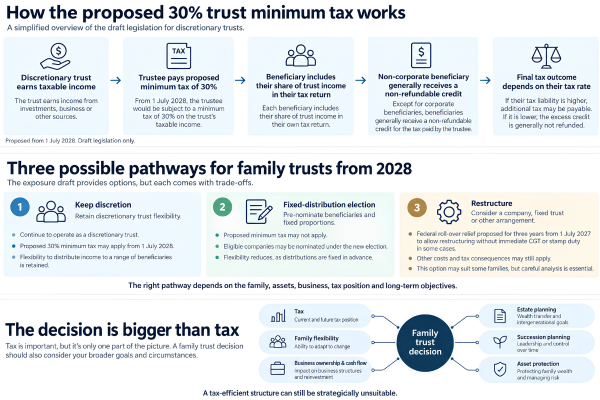
Figure: A simplified overview of the proposed 30% minimum tax, possible pathways and broader family trust considerations.
Does this mean family trusts are safe?
Not quite.
The 3 September material is still exposure draft legislation.
Consultation remains open until 18 September 2026, and Treasury has indicated that further legislation will be required for administrative, integrity and implementation matters.
The final legislation may therefore change again.
That uncertainty is not a reason to ignore the issue.
It is a reason to separate preparation from action.
There is a significant difference between ‘We have not looked at this’ and ‘We understand how this could affect us, we have identified our options, and we are waiting for sufficient certainty before making a major decision.’
The second position is where we believe families should aim to be.
What should you do now if you have a family trust?
For most families, the immediate priority is not restructuring. It is understanding.
-
Map the current structure
Understand what the trust owns, how income is currently distributed, whether corporate beneficiaries are used, and how the trust connects with companies, superannuation, personal assets and estate-planning structures.
-
Understand why the trust exists
Tax may be one reason, but rarely the only reason. Consider asset protection, succession, control, estate planning, investment ownership and the needs of different family members.
-
Identify where the proposed 30% minimum tax could actually affect you
Not every trust will experience the same outcome. The current distribution pattern and tax position of beneficiaries’ matter.
-
Model the fixed-distribution option
The key question is not simply whether it reduces tax. It is whether the family could comfortably live with the reduced flexibility over the longer term.
-
Compare alternatives before changing anything
If a company, fixed trust or another structure is being considered, compare the tax outcome with the legal, financial, estate-planning and administrative consequences.
-
Coordinate the advisers around the family
These reforms sit at the intersection of financial planning, tax, accounting and law. The best outcome is more likely to come from advisers working together than from any one discipline looking at the structure in isolation.
Why “wait and see” can be good advice
Major policy reforms often evolve between announcement and enactment.
We saw this recently with the changes to the proposed Division 296 superannuation tax.
The policy direction remained, but important elements changed as the proposal moved through consultation and the legislative process.
The same principle applies here.
Ignoring a major reform until the last minute can be risky.
But acting too early can be equally costly if assets are moved, structures are dismantled or tax and duty consequences are triggered unnecessarily.
Good advice is not measured by how quickly something changes.
Sometimes its greatest value is preventing a decision that did not need to be made.
So, should you be worried about the 2026 family trust tax changes?
We would use a different word.
You should be aware.
And if your family has a discretionary trust, particularly one that:
- distributes income to a corporate beneficiary or bucket company
- distributes income between family members
- owns a business
- owns property or investment assets
- is part of a succession or estate-planning strategy
then you should also be prepared.
But based on what we know today, there is no universal reason to rush out and dismantle a family trust.
The exposure draft has actually created more potential planning pathways, not fewer.
The important work now is understanding which of those pathways may eventually suit your family.
The rules may change again before 1 July 2028.
Your long-term objectives should remain the anchor.
If your family uses a discretionary trust or corporate beneficiary and you would like to understand how the proposed changes could fit into your broader financial strategy, speak with your HPH adviser. The purpose of the conversation today is not necessarily to change anything. It is to make sure you are ready to make a good decision when greater certainty arrives.
Frequently asked questions
Are family trusts being abolished in Australia?
No. The Government has proposed a 30% minimum tax for many discretionary trusts from 1 July 2028. The reforms do not abolish family trusts.
Will all discretionary trusts pay 30% tax?
No. The proposed rules contain exclusions and the actual effect will depend on the trust, its income and its beneficiaries. A proposed fixed-distribution election may also allow some existing trusts to fall outside the minimum-tax regime.
Can a family trust still use a bucket company?
Potentially. Treasury’s September 2026 draft materials specifically contemplate eligible companies being nominated under the proposed fixed-distribution election. The final rules are not yet law and the suitability of this approach would depend on the family’s circumstances.
When are the proposed family trust tax changes due to start?
The proposed commencement date for the 30% minimum tax is 1 July 2028.
Should I restructure my family trust now?
For now, the priority should be preparation rather than reaction. Use the time before 2028 to understand how the proposed changes could affect your existing structure, what options may be available, and what trade-offs each option could create across tax, estate planning, asset protection, succession and family flexibility. That means bringing your financial, tax and legal advisers together early, modelling the alternatives carefully and avoiding unnecessary changes while the legislation is still evolving.
The goal is not to predict every detail of the final rules. It is to make sure that, once there is enough certainty, you are in a position to make a considered decision that supports your broader financial position and long-term family objectives, rather than reacting under pressure.
General information only. This article contains general information only and has been prepared without taking into account your objectives, financial situation or needs. It does not constitute personal financial advice, taxation advice or legal advice. The proposed minimum tax on discretionary trusts remains subject to consultation, amendment and passage through Parliament. Before making decisions regarding a trust, corporate beneficiary or other structure, you should obtain advice from appropriately qualified financial, taxation and legal advisers having regard to your circumstances.