



Aged Care Funding: Should You Sell, Rent, or Retain the Family Home?
The decision to sell, rent, or retain the family home when moving into residential aged care depends directly on how the property affects three financial pillars: funding the Refundable Accommodation Deposit (RAD) vs. Daily Accommodation Payment (DAP), Means-Tested Care Fees (or Non-Clinical Care Contributions), and ongoing Age Pension entitlements.
For most families, the family home is the largest asset on the balance sheet. Making an emotional or uninformed decision during this transition can unintentionally trigger significant means-tested fees or drastically reduce Centrelink pension entitlements.
- The Core Decision: RAD vs. DAP
Residential aged care accommodation is priced as a lump sum—the Refundable Accommodation Deposit (RAD). However, residents are not legally required to pay a lump sum; they can choose between three payment methods:
- A Lump Sum (RAD): A capital payment that secures the room. Under current rules, the capital is government-guaranteed and returned when the resident leaves the facility (subject to statutory retention deductions for newer entrants).
- A Daily Payment (DAP): A non-refundable daily interest charge calculated on any unpaid RAD balance using the government-set Maximum Permissible Interest Rate (MPIR). For residents entering on or after 1 November 2025, DAPs are indexed to CPI each 20 March and 20 September.
- A Combination: Paying part of the room price as a RAD and converting the remaining balance into a DAP.
Calculating the Daily Accommodation Payment (DAP)
With the MPIR at 8.43% for the quarter beginning, 1 July 2026, an unpaid RAD of $600,000 generates an annual, non-refundable DAP of over $50,000. Where liquid capital is available, this cost differential is a key factor families weigh when deciding how much to pay as a RAD.
- How the Family Home Is Assessed
How Services Australia and the Department of Health assess the family home depends on who lives in it and whether it is retained or sold.
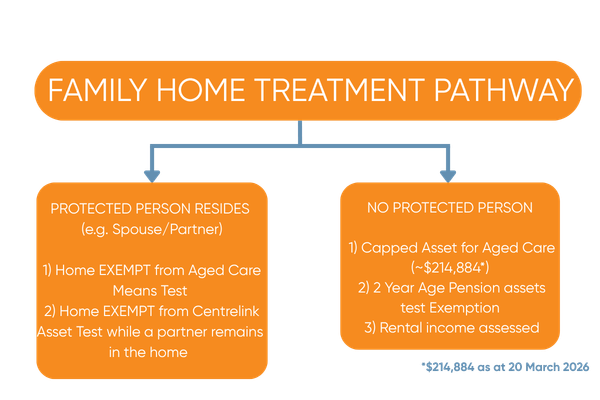
The “Protected Person” Exemption
If a protected person continues living in the home, the property is 100% exempt from the aged care asset test. A protected person includes:
- A spouse or domestic partner.
- A dependent child.
- An eligible carer who has lived in the home for at least 2 years and qualifies for an Australian income support payment.
- A close relative (e.g., sibling/parent) who has lived in the home for at least 5 years and qualifies for an income support payment.
When No Protected Person Lives in the Home
If the home is vacated, two separate assessment frameworks apply:
- For Aged Care Fees: The home is assessed at a capped asset value. ($214,884 on 20th March 2026) or the net market value if lower, regardless of whether the home is worth $700,000 or $3,000,000. The cap is indexed on 20 March and 20 September each year.
- For the Age Pension: The home remains an exempt asset for 2 years from the date the single resident enters care. After 2 years, the aged care resident is classified as a non-homeowner, and the property’s full market value is added to the Centrelink asset test.
- Comparing the Three Strategic Paths
| Strategy | Advantages | Trade-Offs & Risks |
| Option A: Sell the Home | • Liquidates capital potentially allowing payment of the RAD in full, eliminating high non-refundable DAP charges.
• Removes ongoing property maintenance, rates, and insurance costs. |
• Sale proceeds above the RAD become liquid cash/investments, fully assessed under the Age Pension asset test and means-tested care fees.
• May lead to partial or total loss of the Age Pension. |
| Option B: Rent the Home | • Generates rental cash flow to offset daily care fees.
• Retains the home’s aged care asset cap ($214,884).
• Preserves potential long-term property capital growth. |
• Net rental income is assessable for both the Age Pension income test and means-tested aged care fees.
• Landlord obligations, vacancy risk, and the 2-year Age Pension asset exemption countdown. |
| Option C: Retain (Leave Vacant) | • Preserves the $214,884 aged care asset cap.
• Zero rental income to inflate the income test.
• Family retains flexibility to sell later. |
• The property generates no income while still incurring holding costs (council rates, water, power).
• The property insurance may not be valid if it remains vacant for a long period. • Requires alternative capital or super reserves to pay the DAP or RAD.
• The 2-year Age Pension asset exemption countdown. |
- Key Rules to Avoid Costly Traps
- Paying a RAD Protects Pension Entitlements: Money transferred from personal bank accounts to pay an aged care RAD is exempt from the Centrelink Age Pension assets test and deeming rules. However, the RAD is counted as an asset for calculating aged care means-tested daily fees.
- The 2-Year Centrelink Exemption Clock: If a single resident leaves their home empty or rents it out, the home is exempt from the Centrelink asset test for exactly 2 years. On the second anniversary of entering care, the full market value becomes assessable, which often eliminates the Age Pension unless strategic restructuring occurs beforehand.
- Capital Gains Tax (CGT) Main Residence Exemption: A former principal place of residence can generally retain its CGT exemption for up to 6 years if rented out, or indefinitely if left vacant, provided no other property is treated as the main residence.
- The 28-day rule: a resident can’t be required to choose their payment method until 28 days after entry, and a provider can’t accept a lump sum that would leave them below the minimum permissible asset amount.
Frequently Asked Questions
Will selling the family home reduce the Age Pension?
Yes, in many cases. While the home itself is exempt from the Centrelink asset test for the first 2 years, converting that home into cash makes the net sale proceeds fully assessable. If those funds are not placed into an exempt vehicle (such as paying a RAD), the increased financial assets can significantly reduce or cancel your Age Pension under the asset test.
Is a Refundable Accommodation Deposit (RAD) protected if the provider collapses?
Yes. Under the Australian Government’s Accommodation Payment Guarantee Scheme, 100% of the refundable balance of a RAD is guaranteed by the Commonwealth in the event that an approved provider enters bankruptcy or insolvency.
Can you draw down the DAP from the paid RAD?
Yes. If a resident pays a partial RAD, they can formally request the provider to deduct the ongoing from the RAD balance, and the provider must agree to this for accommodation costs. Other fees can also be deducted, but only if the provider agrees. However, as the RAD balance diminishes, the daily DAP interest charge increases accordingly.
This article is intended for informational purposes only and does not constitute personal financial, legal, or aged care advice. Legislation, MPIR rates, and Means-Tested Care thresholds change regularly, and different rules apply depending on when a resident entered care. Before making decisions regarding property or aged care funding, seek advice from an authorised financial adviser with aged care accreditation.