



The greatest risk to a retirement portfolio is not market volatility itself, it is the timing of that volatility.
Experiencing a market downturn during the early years of drawing an Account-Based Pension can impact the longevity of your retirement savings, a structural danger known as sequencing risk.
By implementing a three-tiered “Bucket Strategy,” retirees can build a structural buffer that funds immediate living expenses without forcing the sale of growth assets at cyclical market lows.
What Is Sequencing Risk in Retirement?
Sequencing risk (or sequence of returns risk) is the danger that the timing of market declines will disproportionately erode a portfolio during the early decumulation phase.
When a retiree draws regular cash payments from a declining portfolio, a larger proportion of growth units must be liquidated to produce the same dollar income. Even if long-term market averages recover, the capital base is permanently reduced because fewer units remain to participate in subsequent market rebounds.
The Decumulation Paradox: Accumulation vs. Drawdown
During the wealth accumulation phase, market volatility is manageable dollar-cost averaging allows regular superannuation contributions to purchase more assets at cheaper valuations during market pullbacks.
During the decumulation phase, the equation flips into reverse dollar-cost averaging:
- Fixed Cash Outflows: Required living expenses remain fixed or increase with inflation.
- Compounded Unit Loss: Selling growth assets (such as Australian and global equities) during a 15% to 20% drawdown locks in paper losses permanently.
- Shortened Portfolio Longevity: Portfolios subjected to poor sequence of returns in the first 3 to 5 years of retirement often exhaust their capital 5 to 10 years earlier than projected, even with identical average 30-year returns.
The Three-Bucket Framework: Structuring Capital Longevity
The bucket strategy divides an Account-Based Pension into three distinct tiers based on time horizon, liquidity requirements, and risk tolerance.
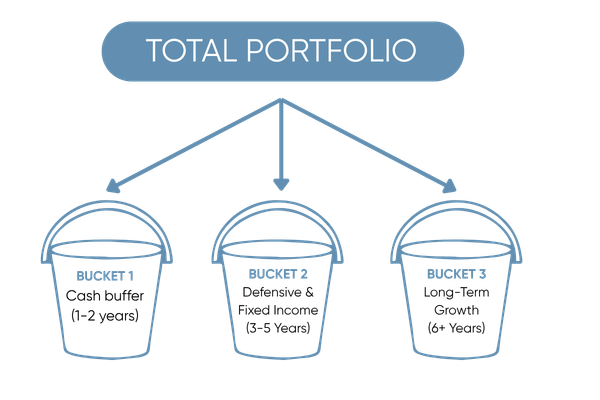
| Component | Horizon | Typical Target Allocation | Asset Classes & Role |
| Bucket 1: Cash Buffer | 1 to 2 Years | ~5% to 10% | High-yield cash, term deposits, and at-call cash reserves.
This bucket funds fortnightly or monthly pension payments and has zero capital volatility. |
| Bucket 2: Defensive & Income | 3 to 5 Years | ~15% to 25% | Short-duration bonds, investment-grade fixed income, capital-stable credit.
This bucket acts as a replenishment reservoir for Bucket 1 during extended downturns. |
| Bucket 3: Long-Term Growth | 6+ Years | ~65% to 80% | Australian equities, international equities, direct/listed property, infrastructure.
This bucket delivers capital growth to combat long-term inflation. |
How the Strategy Works in Practice
The strategic value of this framework lies in the rules governing how and when capital moves between buckets.
Scenario A: In Bull or Stable Markets
Dividends, franking credit refunds, and realised capital gains from Bucket 3 are systematically harvested and transferred directly into Bucket 1 and Bucket 2, keeping the liquid cash buffers fully funded.
Scenario B: In a Severe Bear Market
When growth assets experience a substantial pullback, the harvesting from Bucket 3 stops entirely. The retiree continues to draw income exclusively from Bucket 1 (Cash).
If the downturn extends beyond 18 to 24 months, conservative assets in Bucket 2 (Defensive) are liquidated to top up Bucket 1.
This mechanism provides a 3-to-7-year runway, allowing equities in Bucket 3 sufficient time to recover without crystallising paper losses.
Key Strategic Trade-Offs & Execution Risks
While the bucket strategy solves the psychological and mathematical pressures of sequencing risk, it requires disciplined management:
- Cash Drag: Holding 1 to 2 years of living expenses in cash creates a performance drag during strong bull markets. The cash allocation must be calibrated strictly to net income needs (total expenses minus any external income like Age Pension or rental yields), rather than total portfolio percentages.
- Rebalancing Discipline: The system fails if there is no clear rebalancing protocol. Decisions regarding when to trim equities after a rally or when to let cash run down during a correction must be defined in advance, not made emotionally.
- Superannuation Platform Constraints: Not all super platforms allow granular, multi-layered asset management inside a single Account-Based Pension account. Ensuring the underlying structure supports automated drawdown from specific sub-asset classes is essential.
Frequently Asked Questions
How much cash should a retiree hold in an account-based pension?
Most financial models recommend holding between 12 and 24 months of net living expenses in liquid cash reserves. This should be calculated as your total annual lifestyle cost minus reliable, guaranteed income streams (such as the Age Pension, commercial rent, or defined benefit pensions).
Does the bucket strategy reduce total investment returns?
Holding higher cash reserves can produce a minor drag on nominal returns during extended bull markets. However, in the decumulation phase, eliminating sequencing risk and avoiding crystallising capital losses during downturns provides far greater capital protection than chasing peak theoretical returns.
How do franking credits fit into the bucket strategy?
Inside an Account-Based Pension, investment earnings are taxed at 0%. This means imputation credits attached to Australian franked dividends are typically refunded to the account in cash by the ATO after the fund’s tax return is finalised. These cash refunds flow directly into Bucket 1, helping replenish cash reserves organically without needing to sell shares.
This article is intended for informational purposes only and does not constitute personal financial, tax, or legal advice. It has been prepared without considering your individual objectives, financial situation, or needs. Before acting on any information, you should consider its appropriateness to your circumstances and seek professional advice from a financial adviser.