


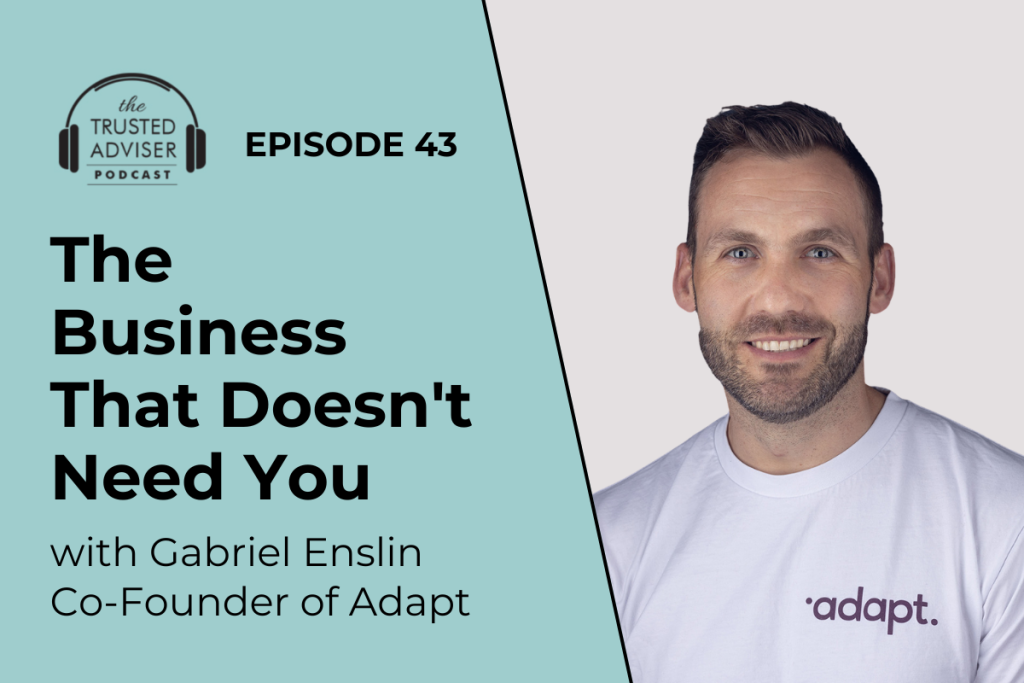
In this episode of the Trusted Adviser Podcast, Rob Pyne interviews Gabe Enslin, Co-Founder of ADAPT, who shares insights on building resilient businesses that don’t rely solely on their owners. The conversation delves into the origin of ADAPT, the importance of succession thinking over planning, and the five principles that guide business owners towards creating a sustainable organization. Gabe emphasizes the significance of role clarity, the challenges owners face in letting go, and the value of reverse performance reviews to enhance business resilience. In this conversation, Gabe and Rob discuss the critical aspects of employee and customer retention, emphasizing the importance of understanding needs and motivations. They explore the significance of cultural health checks and the necessity of non-anonymous feedback to gauge employee satisfaction. The dialogue also highlights the impact of ownership alignment on business success and the common weaknesses in organizational design within financial planning firms. Gabe introduces the concept of a business resilience assessment and the need for a structured framework to ensure lasting success. They conclude with a call to action for business owners to proactively plan for their future and take meaningful steps towards resilience.
LISTEN
SHOW NOTES
Topics Discussed
- Why many advisory firms misunderstand the role of marketing.
- The difference between tactical marketing and strategic positioning.
- Human-centred design thinking in financial advice businesses.
- Building brands that clients emotionally connect with.
- Common mistakes advisory firms make on their websites.
- The role of professional marketers versus internal coordinators.
- The growing importance of data analytics in marketing.
- How AI is reshaping marketing productivity and content creation.
- Why publishing deep expertise builds long-term trust and visibility.
- Using website chat tools and AI chatbots for client engagement.
- Measuring marketing success through leads, clients, and revenue.
- Understanding client behaviour through analytics tools and user data.
- Identifying ideal clients and the life events that trigger financial advice.
Episode Highlights
(Timestamps are approximate)
- [00:00] – Introduction to Gabe Enslin and Adapt
- [01:15] – The origin story: crisis, dependency, and the birth of Adapt
- [03:07] – Why corporate frameworks fail SMEs
- [05:12] – Ownership vs employment: why SME design is different
- [06:10] – Succession thinking vs succession planning
- [09:33] – The five principles of a business that doesn’t need you
- [10:56] – Why role clarity is the biggest blind spot
- [11:24] – The three layers of accountability in SMEs
- [13:15] – Why position descriptions fail and roles matter more
- [15:45] – Structured handovers vs chaotic delegation
- [17:06] – When a business is ready for this level of thinking
- [19:57] – Letting go: the hardest shift for business owners
- [22:03] – Building trust through small handovers
- [25:49] – Reverse performance reviews and employee insight
- [29:04] – Business resilience assessments explained
- [33:15] – Cultural health checks vs meaningful conversations
- [41:03] – Why organisational design is the weakest link in advice firms
- [44:06] – Building a business operating system that lasts
- [50:55] – Warning signs owners are leaving it too late
- [53:44] – The one action every owner should take today
- [55:34] – How to engage with Adapt and next steps
Quotes from Gabe Enslin
“Being a business owner can feel stuck, lonely, and overwhelming when the business depends on you.”
“Succession thinking is proactive. Succession planning is reactive.”
“If you build a business for succession early, it becomes stronger, more profitable, and more efficient anyway.”
“Role clarity is always the first problem and the most underestimated.”
“You cannot hand over a role that hasn’t been defined.”
“If you don’t let go, you stay stuck.”
“If your people get what they need from you, they won’t leave.”
“A business is just a group of people solving a common problem.”
“The business is only as transferable as the owner is willing to become.”
“Figure out what you want your life to look like, then build the business to support that.”
Key Takeaways
- Bill Withers founded ADAPT to help SME owners feel less overwhelmed.
- Succession thinking is proactive; succession planning is reactive.
- Role clarity is often underestimated in business.
- A resilient business can thrive without the owner’s constant involvement.
- Business owners must let go to build a transferable business.
- Reverse performance reviews provide valuable insights from employees.
- Understanding employee motivation is key to retention.
- Building a resilient business requires trust in the team.
- The owner’s behavior can hinder business growth.
- Starting small in delegation can lead to significant results. If your customer or employee gets what they need, they won’t leave.
- Cultural health checks should be frequent to catch issues early.
- Non-anonymous feedback is crucial for understanding employee needs.
- Ownership alignment is key to preventing business failure.
- Organizational design is often a weak point in financial planning firms.
- A business resilience assessment can identify areas needing attention.
- Good leadership and strategy are essential for business health.
- Proactive planning can prevent pain points in business operations.
- Understanding personal circumstances of employees can improve retention.
- Business owners should regularly assess their long-term goals.
Resources & Links
- The Trusted Adviser: https://thetrustedadviser.com.au/
- Adapt: https://www.theadaptway.com/
- Connect with Rob Pyne on LinkedIn
- Connect with Gabe Enslin on LinkedIn
- Follow The Trusted Adviser Podcast
Show notes and transcript
For the full show notes and transcript from this episode, head to the episode page on The Trusted Adviser Website here.