


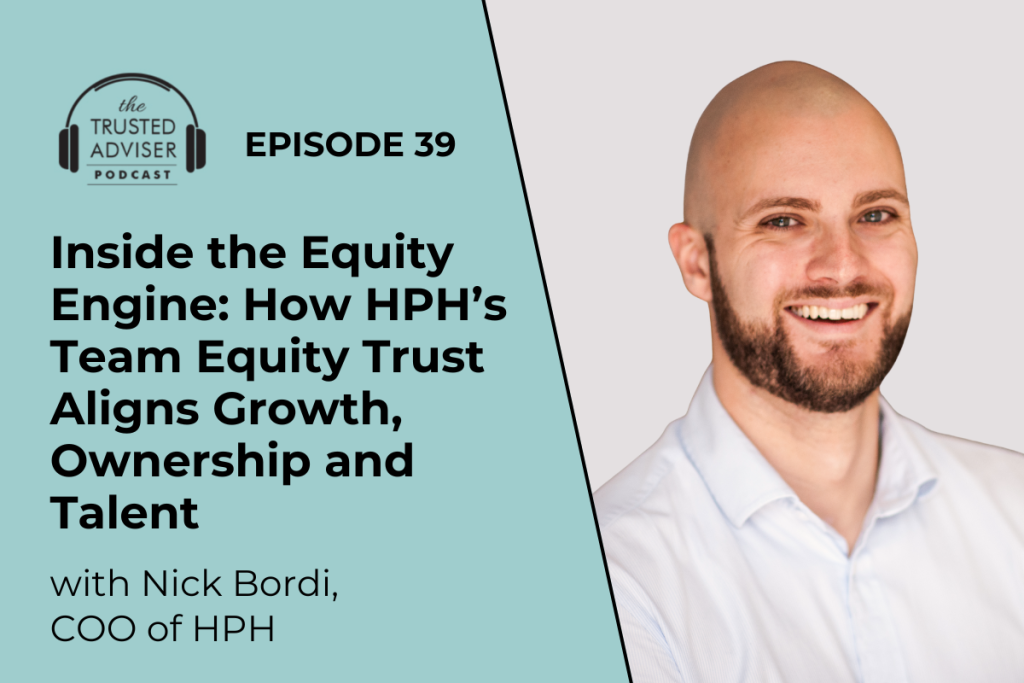
In this episode of the Trusted Adviser Podcast, Rob Pyne sits down with HPH COO Nick Bordi to unpack one of the most strategically important, yet often misunderstood, levers in building a high-performing advice firm: equity ownership.
This isn’t theory. It’s a practical, behind-the-scenes look at how HPH has structured its Team Equity Trust (employee share plan) to align its people with the long-term success of the business, and why that alignment is becoming a competitive advantage in attracting, retaining and developing top talent.
Nick shares his own journey from adviser to COO, and how stepping into leadership gave him a front-row seat to the challenges of scaling a firm while maintaining culture, performance, and accountability.
The conversation goes deep into how the trust works, why it was created, and the commercial thinking behind it, including how equity can be used not just as a reward, but as a strategic tool for behaviour, decision-making, and firm-wide alignment.
Rob and Nick also explore the broader implications for advice firms navigating growth, acquisitions, and succession, and why traditional ownership models are increasingly being challenged.
LISTEN
WHAT YOU’LL LEARN
- Why most advice firms get equity structures wrong, and the unintended consequences
- The difference between ownership as a reward vs ownership as a strategy
- How HPH’s Team Equity Trust actually works in practice
- The role equity plays in retention, accountability and performance culture
- How to think about fairness vs contribution when allocating ownership
- Why equity structures are critical for scaling beyond founder-led growth
- The commercial realities of balancing risk, reward and control
- How employee ownership can support succession planning and long-term sustainability
KEY INSIGHTS
1. Equity changes behaviour, not just outcomes
When structured properly, equity shifts how people think, act and make decisions. It creates a mindset of ownership that salary and bonuses alone can’t replicate.
2. Alignment beats incentives
Short-term incentives can drive activity. Equity drives alignment with the long-term direction of the business, which is where real value is created.
3. Not everyone should have equity, and that’s the point
A well-designed structure is selective. It rewards contribution, leadership and long-term commitment, not tenure alone.
4. Growth creates complexity, equity helps manage it
As firms scale, maintaining culture and accountability becomes harder. Equity structures can act as a unifying mechanism across teams and leadership layers.
5. The model is evolving
Traditional “founder owns everything” models are being challenged. Firms that rethink ownership structures early are better positioned for sustainable growth and succession.
QUOTES
- “Equity isn’t just about sharing the upside, it’s about aligning how people think about the business.”
- “If you want people to act like owners, you need to give them a reason to think like one.”
- “The real value isn’t in the shares, it’s in what those shares represent in behaviour and accountability.”
- “Growth without alignment creates friction. Equity is one way to solve that.”
EPISODE HIGHLIGHTS
[00:01] – Introduction: Lifting the Lid on the Team Equity Trust
Rob sets the context — this is a deeper, more refined unpack of HPH’s Team Equity Trust and why it matters.
[00:57] – Nick Bordi’s Journey: From Associate to COO
Nick shares his path through HPH, from adviser to executive leadership, and how that perspective shapes how he views the business today.
[01:58] – The Shift to Leadership and Scaling the Business
Discussion around growth, acquisitions, and the need to evolve beyond purely adviser-led roles.
[~03:30] – Why This Conversation Matters
Framing the real issue: most firms don’t think about ownership structures early enough – and it costs them later.
[~06:00] – The Problem with Traditional Ownership Models
Exploration of founder-heavy models and the limitations they create around growth, succession, and team engagement.
[~09:30] – Introducing the Team Equity Trust
A clear explanation of what the structure is, why it was created, and how it differs from typical employee share plans.
[~14:30] – Ownership as Strategy, Not a Reward
A critical distinction — equity isn’t just something you “give”, it’s something you design to influence behaviour and outcomes.
[~20:00] – Who Gets Equity (and Why That Matters)
The importance of selectivity, contribution, and alignment — not just tenure.
[~25:30] – How Equity Changes Behaviour Inside the Firm
Real insight into how ownership shifts accountability, thinking, and decision-making across the team.
[~31:00] – Balancing Fairness, Risk and Control
The commercial realities behind structuring equity, including trade-offs leaders need to manage.
[~37:30] – Retention and Talent Strategy
How equity becomes a differentiator in attracting and keeping high-quality people.
[~43:00] – Scaling Beyond the Founder Model
Why evolving ownership is essential for firms that want to grow sustainably.
[~48:30] – Succession Planning Done Right
How structures like this solve one of the biggest long-term risks in advice businesses.
[~53:30] – Final Reflections: The Future of Ownership in Advice Firms
Closing thoughts on where the industry is heading, and what forward-thinking firms should be doing now.
TAKEAWAY
Most firms think about equity too late; or treat it as a reward mechanism. The smarter firms are using it earlier and more strategically to shape behaviour, align teams, and build something that outlasts the founders.